
The Challenge
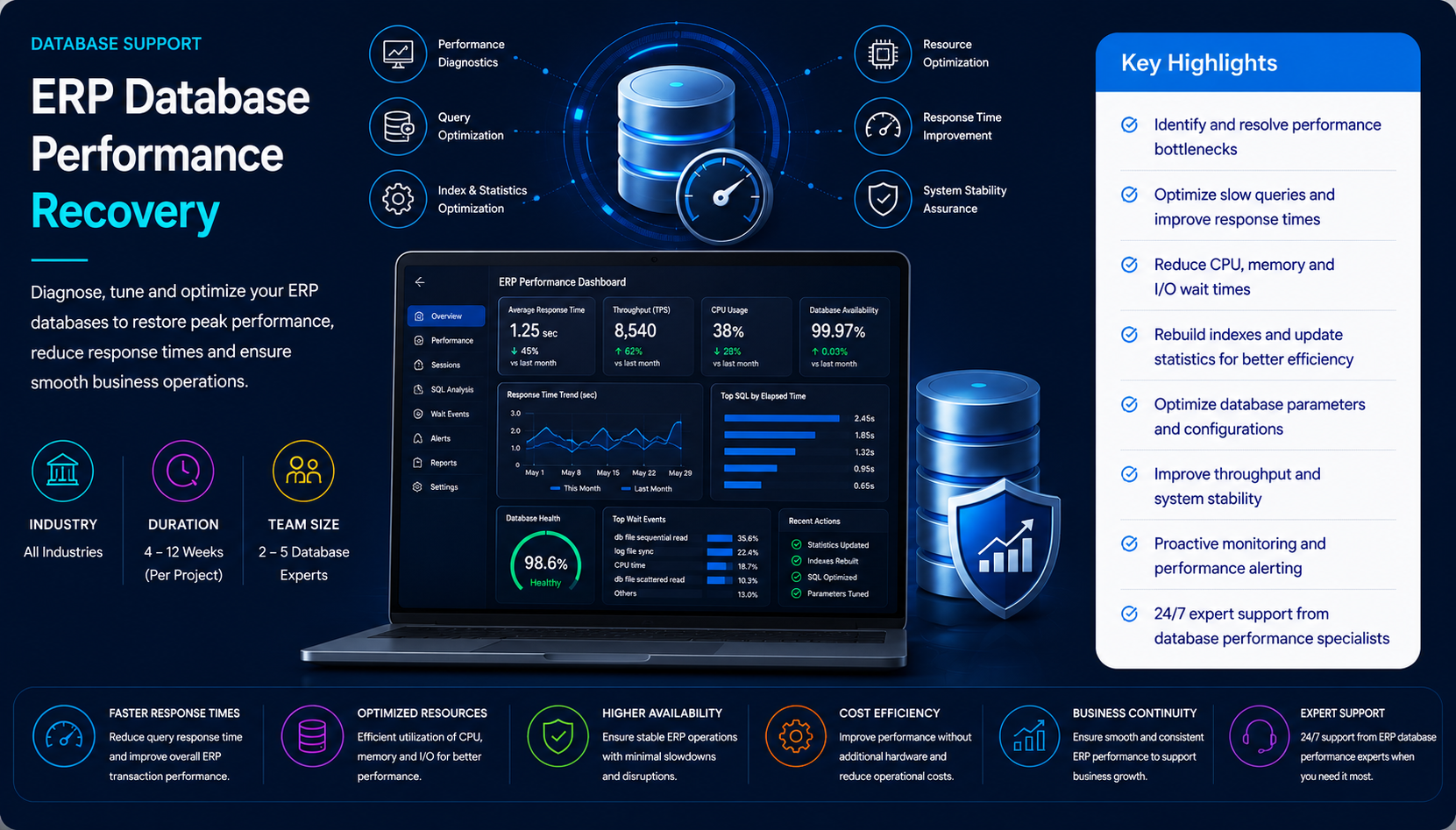
ERP database performance issues affected response times and operational users, while troubleshooting was complicated by workload and configuration factors.
ERP transactions experienced slow response times
Database workload patterns were difficult to isolate
Performance tuning was reactive
Operational teams needed clearer database health visibility

Our Solution
We analyzed the ERP database workload, addressed performance bottlenecks and established operational controls for sustained database health.
Workload and query analysis
Performance tuning and configuration review
Index and execution optimization
Operational monitoring and recovery controls
Key Features
Database workload analysis
Query performance review
Index optimization
Resource and configuration tuning
Performance monitoring
Implementation Approach
The recovery combined workload analysis, targeted tuning, controlled validation and post-change monitoring.
Captured workload and performance baselines
Identified high-impact queries and bottlenecks
Applied targeted tuning changes
Validated ERP transaction performance
Established monitoring and recovery practices
Business Impact
Improved ERP response consistency
Reduced performance bottlenecks
Faster identification of database issues
Greater confidence in operational stability

Outcomes
A stabilized ERP database environment
Improved transaction performance
Repeatable performance-monitoring practices
Clearer path for future optimization

Technology Direction
The database foundation can progress toward proactive monitoring, capacity planning, high availability and modernization of supporting data services.
Scalable architecture aligned to the client’s operating model.
Secure data handling and controlled access.
Integration-ready foundations for connected systems.
Clear path for analytics, automation and future enhancement.
Technologies Used
OracleSQL ServerSQLPerformance TuningMonitoring
Service Capabilities
Performance TuningData Optimization
Similar Case Studies
Explore related projects delivered under Database Support.