
The Challenge
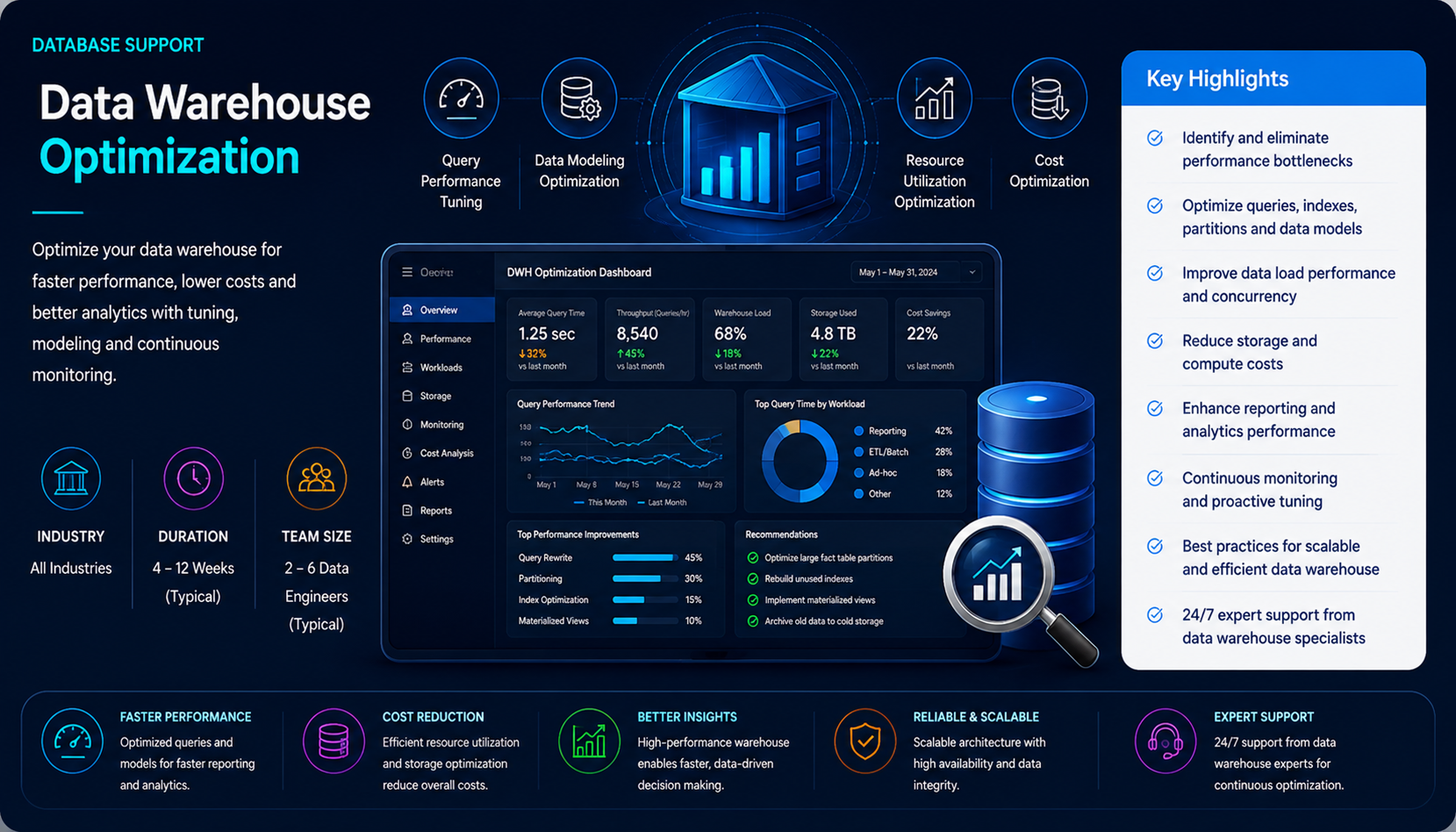
Analytics workloads were taking longer as data volumes grew, making recurring reporting and warehouse queries less predictable.
Growing data volumes increased query times
Recurring analytical workloads competed for resources
Performance bottlenecks were difficult to isolate
Reporting teams needed more predictable execution

Our Solution
We optimized the data warehouse around workload patterns, query behavior and data-access paths to improve analytical performance.
Warehouse workload analysis
Query and data-access optimization
Indexing and partitioning review
Performance monitoring
Key Features
Workload profiling
Query optimization
Data-access tuning
Storage and indexing review
Performance monitoring
Implementation Approach
Optimization focused on measured workloads, targeted query changes and validation against representative analytical reports.
Profiled warehouse workloads
Identified high-cost queries
Optimized access paths and structures
Validated report execution
Established ongoing performance checks
Business Impact
Faster analytical queries
More predictable reporting cycles
Better warehouse resource utilization
Reduced performance troubleshooting effort

Outcomes
A more responsive analytics warehouse
Improved reporting performance
Repeatable tuning practices
Foundation for growing data volumes

Technology Direction
The warehouse can progress toward workload automation, scalable storage patterns, stronger observability and modern analytics architecture.
Scalable architecture aligned to the client’s operating model.
Secure data handling and controlled access.
Integration-ready foundations for connected systems.
Clear path for analytics, automation and future enhancement.
Technologies Used
SQLPostgreSQLETLPower BIQuery Optimization
Service Capabilities
Data OptimizationPerformance Tuning
Similar Case Studies
Explore related projects delivered under Database Support.